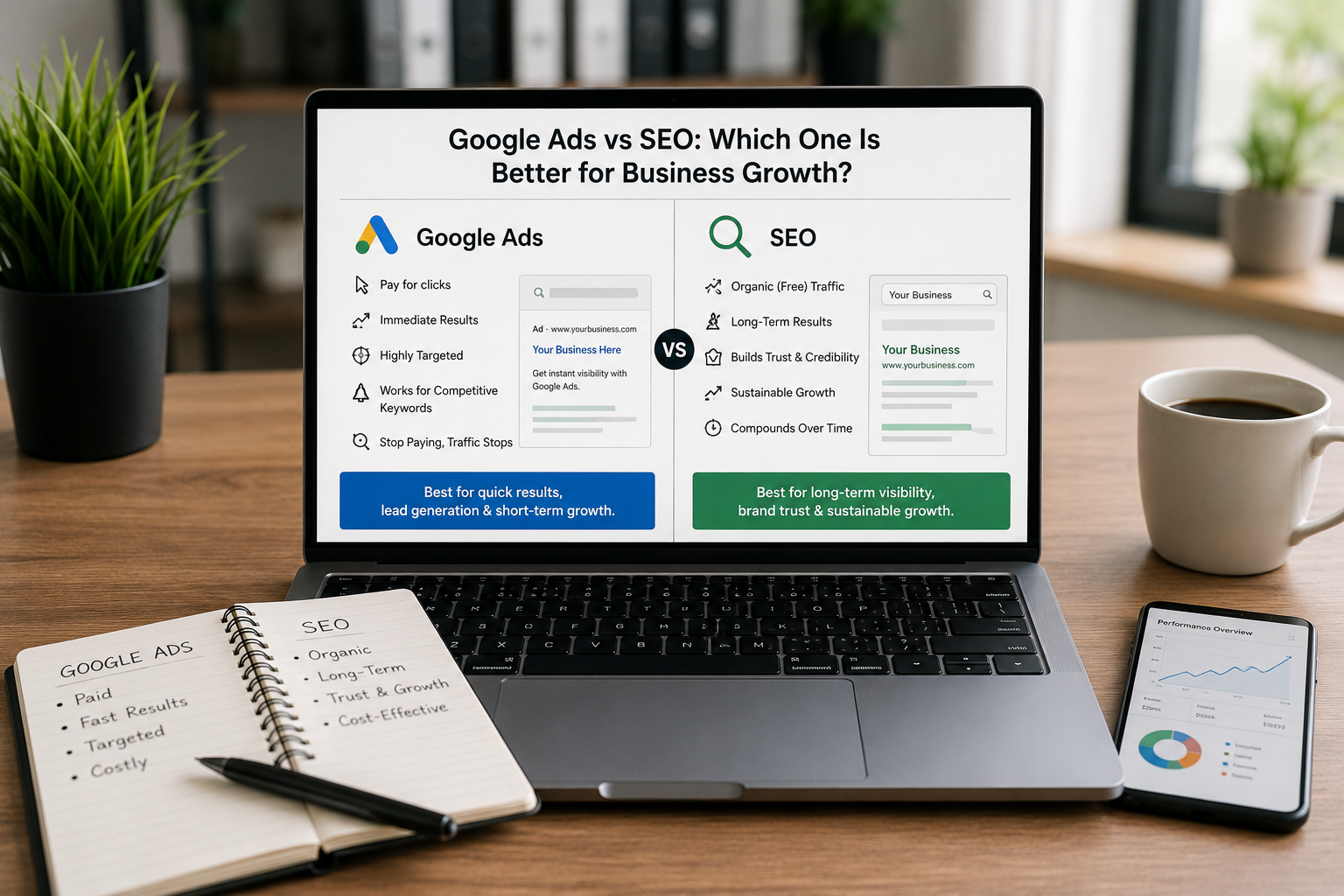

In the ever-evolving world of digital marketing, businesses constantly face an important question: Should we invest in SEO or Google Ads? Both strategies can drive traffic, generate leads, and increase revenue, but they work in fundamentally different ways.
As competition grows online in 2026, businesses must carefully choose where to allocate their marketing budgets. While some companies prefer the immediate results of Google Ads, others focus on the long-term benefits of Search Engine Optimization (SEO). The truth is that both strategies have unique advantages, and understanding their differences can help businesses make smarter marketing decisions.
In this comprehensive guide, we’ll compare Google Ads and SEO across multiple factors, including cost, speed, sustainability, lead quality, and return on investment, to determine which approach is better for business growth.
Understanding Google Ads
Google Ads is Google’s paid advertising platform that allows businesses to display advertisements on search results pages, websites, YouTube, and other Google-owned properties.
When users search for specific keywords, businesses can bid on those terms to display their ads at the top of search results.
For example:
A digital marketing agency may bid on keywords such as:
- SEO services
- Digital marketing agency
- PPC management company
- Local SEO services
When users search for these terms, paid advertisements appear before organic results.
How Google Ads Works
Google Ads operates on a Pay-Per-Click (PPC) model.
Businesses pay when someone clicks on their advertisement.
The cost depends on:
- Keyword competition
- Industry
- Ad quality
- Landing page experience
- Bid strategy
Higher competition generally results in higher advertising costs.
Understanding SEO
Search Engine Optimization (SEO) focuses on improving a website’s organic visibility in search engine results.
Instead of paying for clicks, businesses optimize their websites to rank naturally for relevant search queries.
SEO includes:
- Keyword research
- Content creation
- Technical optimization
- Link building
- User experience improvements
- Local SEO strategies
The goal is to earn sustainable organic traffic over time.
Google Ads vs SEO: Key Differences
1. Speed of Results
Google Ads
Google Ads delivers immediate visibility.
Once campaigns are launched and approved, advertisements can start generating traffic within hours.
Benefits include:
- Instant traffic
- Immediate lead generation
- Fast testing opportunities
- Quick market validation
Businesses needing immediate results often choose Google Ads.
SEO
SEO requires patience.
It may take several months before significant ranking improvements appear.
Factors affecting SEO timelines include:
- Website age
- Competition level
- Content quality
- Domain authority
However, once rankings improve, traffic becomes more sustainable.
Winner: Google Ads
For immediate results, Google Ads is the clear winner.
2. Long-Term Value
Google Ads
Google Ads provides results only while campaigns remain active.
When advertising budgets stop:
- Traffic stops
- Leads stop
- Visibility disappears
Businesses must continue spending to maintain results.
SEO
SEO creates long-term digital assets.
A well-optimized page can generate traffic for years without additional advertising costs.
Benefits include:
- Ongoing traffic
- Brand authority
- Sustainable lead generation
- Reduced customer acquisition costs
Winner: SEO
For long-term growth and sustainability, SEO offers greater value.
3. Cost Comparison
Google Ads Costs
Advertising costs vary significantly depending on industry competition.
Highly competitive sectors often experience:
- Expensive clicks
- Rising acquisition costs
- Continuous budget requirements
Businesses may spend thousands of dollars monthly to maintain visibility.
SEO Costs
SEO typically involves:
- Content creation
- Website optimization
- Technical improvements
- Link-building efforts
Although initial investments can be substantial, ongoing costs are often lower than continuous advertising expenses.
Winner: SEO
Over time, SEO usually provides a lower cost per acquisition.
4. Credibility and Trust
Google Ads
Users recognize advertisements as paid placements.
While ads generate visibility, some users prefer organic results.
SEO
Organic rankings often carry greater credibility.
Many consumers trust businesses that appear naturally on the first page of search results.
Higher rankings suggest:
- Expertise
- Authority
- Reliability
Winner: SEO
Organic visibility generally builds stronger trust.
5. Lead Quality
Google Ads
Google Ads allows businesses to target:
- Specific keywords
- Geographic locations
- Demographics
- Interests
- Devices
This precision often generates highly targeted traffic.
SEO
SEO attracts users actively searching for information, products, or services.
Organic visitors often demonstrate strong purchase intent.
Winner: Tie
Both strategies can generate high-quality leads when implemented effectively.
6. Click-Through Rates
Google Ads
Paid ads often receive significant visibility, especially for commercial keywords.
However, some users intentionally skip advertisements.
SEO
Organic listings frequently achieve higher click-through rates because users perceive them as more trustworthy.
Top-ranking organic pages often receive the majority of clicks.
Winner: SEO
Organic search results generally attract more clicks over time.
7. Competitive Advantage
Google Ads
Businesses can compete immediately, regardless of website authority.
Even new companies can gain visibility through advertising.
SEO
Competing organically may be more difficult in highly competitive industries.
Established websites often have stronger authority and backlink profiles.
Winner: Google Ads
Google Ads provides faster competitive entry.
8. Brand Awareness
Google Ads
Ads help businesses gain immediate exposure across:
- Search results
- Display networks
- YouTube
- Mobile apps
SEO
SEO builds brand awareness gradually through consistent visibility.
Repeated appearances in organic search results strengthen recognition.
Winner: Tie
Both channels contribute effectively to brand awareness.
9. Scalability
Google Ads
Scaling Google Ads is relatively straightforward.
Businesses can:
- Increase budgets
- Expand keyword targeting
- Launch new campaigns
However, higher spending is required.
SEO
Scaling SEO involves:
- Publishing additional content
- Expanding keyword coverage
- Improving authority
Growth may be slower but often becomes more cost-effective over time.
Winner: Google Ads
Paid advertising scales faster.
10. Return on Investment (ROI)
Google Ads ROI
Google Ads can generate excellent returns when campaigns are optimized properly.
However, rising advertising costs can reduce profitability.
SEO ROI
SEO frequently delivers exceptional long-term ROI because traffic continues after initial investments.
Many businesses report lower acquisition costs through organic search.
Winner: SEO
Long-term ROI generally favors SEO.
When Should You Choose Google Ads?
Google Ads is ideal when:
- You need immediate traffic
- Launching a new website
- Promoting limited-time offers
- Testing new products
- Entering competitive markets
- Generating leads quickly
Businesses seeking fast results often start with PPC campaigns.
When Should You Choose SEO?
SEO is ideal when:
- Building long-term growth
- Establishing industry authority
- Reducing customer acquisition costs
- Improving brand trust
- Increasing sustainable traffic
- Creating long-term digital assets
Businesses focused on future growth often prioritize SEO.
Why the Best Strategy Is Often Both
Many successful businesses combine Google Ads and SEO.
Benefits of Combining Both
Immediate Results + Long-Term Growth
Google Ads generates traffic immediately while SEO builds future visibility.
More Search Engine Real Estate
Businesses can appear in both paid and organic results simultaneously.
This increases:
- Brand exposure
- Click-through rates
- Customer trust
Better Keyword Insights
Google Ads data can help identify high-converting keywords for SEO campaigns.
Increased Conversion Opportunities
Multiple touchpoints improve the likelihood of customer engagement and conversions.
Example Scenario
Imagine a local digital marketing agency launching a new website.
Month 1–3
The agency uses Google Ads to:
- Generate immediate leads
- Build brand awareness
- Test keyword performance
Month 3–12
The agency invests in:
- SEO content
- Technical optimization
- Local SEO
- Link building
After One Year
The website begins ranking organically, reducing reliance on paid advertising and lowering customer acquisition costs.
This hybrid approach often produces the best results.
Common Mistakes Businesses Make
Relying Only on Ads
Many businesses become dependent on advertising and struggle when budgets decrease.
Expecting Instant SEO Results
SEO requires patience and consistent effort.
Ignoring Landing Page Optimization
Traffic is ineffective if websites fail to convert visitors.
Not Tracking Performance
Businesses should monitor:
- Leads
- Conversion rates
- Cost per acquisition
- Return on investment
Data-driven decisions improve outcomes.
The Future of Search Marketing
In 2026 and beyond, search marketing will continue evolving through:
- AI-powered search experiences
- Voice search growth
- Personalized results
- Enhanced automation
- Better audience targeting
Businesses that combine paid and organic strategies will remain competitive in changing digital environments.
Conclusion
The debate between Google Ads and SEO doesn’t have a one-size-fits-all answer. Google Ads delivers immediate traffic and fast results, making it ideal for short-term campaigns and rapid lead generation. SEO, on the other hand, provides sustainable growth, stronger credibility, and superior long-term return on investment.
For most businesses, the smartest strategy is not choosing one over the other but leveraging both. Google Ads can generate immediate opportunities while SEO builds a lasting foundation for future growth.
If your goal is quick visibility, Google Ads is the better choice. If your goal is sustainable business growth and long-term profitability, SEO remains the most powerful investment. Businesses that effectively combine both strategies are often the ones that achieve the greatest success in today’s competitive digital landscape.